
Over the last couple of years, there has been an increasing sentiment that young South African players are not allowed to grow and develop in the local top-tier football eco-system. In 2019 SA went to the African Cup of Nations in Egypt with the second oldest squad in the tournament. It was nearly 2 full years older than the tournament average of 27.6 years. An increasing number of young players are popping up all over the world recently has also made many of us wonder why that was the case. The squad analysis of the Premier Soccer League in comparison with Africa’s top 5 leagues i.e. Egyptian Premier League, Moroccan Botola, Tunisia Ligue 1, and Algeria Ligue Professionale showed that not only does SA have the highest number of international players in its league, but it also has the oldest average squads of all 5. Throughout all of this time, however, we did not have objective irrefutable evidence that indeed our youth was being overlooked in the South Africa top tier league until now.
The Sport Boardroom analyzed the data by the CIES’s Football Observatory on the demographic profile of the selected 15 global leagues. This covered the big 5 leagues in Europe i.e. England, Spain, Germany, Italy, and France as well as the South American leagues of Brazil, Argentina, Chile, and Colombia. We also looked at the Asian league of Korea, Japan, China, and Australia and finally CONCACAF’s Mexico and USA/ Canada leagues and we added the South African Premier Soccer League to that mix. The table below shows the 16 leagues, the number of players who played, the number of teams per league, the number of matches covered by the analysis, the number of games assuming a full home and away league program, and the percentage of games analyzed as a proportion of the full conventional football season.
League | No. of Players Fielded | No. of Clubs | No. of Matches analyzed | Games per full season* | % Games analyzed |
Liga Profesional Argentina (ARG) | 773 | 26 | 325 | 650 | 50 |
A-League (AUS) | 231 | 12 | 31 | 132 | 23 |
Brasileirão (BRA) | 680 | 20 | 309 | 380 | 81 |
Primera División (CHI) | 491 | 17 | 193 | 272 | 71 |
Super League (CHN) | 422 | 16 | 126 | 240 | 53 |
Primera A (COL) | 585 | 20 | 226 | 380 | 59 |
Premier League (ENG) | 479 | 20 | 183 | 380 | 48 |
La Liga (ESP) | 520 | 20 | 182 | 380 | 48 |
Ligue 1 (FRA) | 503 | 20 | 188 | 380 | 49 |
Bundesliga (GER) | 447 | 18 | 153 | 306 | 50 |
Serie A (ITA) | 508 | 20 | 189 | 380 | 50 |
J1 League (JPN) | 509 | 20 | 187 | 380 | 49 |
K League 1 (KOR) | 345 | 12 | 117 | 132 | 89 |
Liga MX (MEX) | 487 | 18 | 171 | 306 | 56 |
MLS (USA/CAN) | 696 | 27 | 334 | 702 | 48 |
Premier Soccer League (SA) | 486 | 16 | 160 | 240 | 67 |
* Not all leagues use a standard conventional home and away league format. This column assumes that to be the case for ease of comparison.
The chart shows how the 16 leagues compare on the various squad measurements covering the average age of the teams fielded by each league across the matches analyzed, the percentage of under 21-year-olds fielded over those matches, the percentage of players 30 years and older that were fielded and the percentage core squad that is 21- to 29-year-olds that were fielded in the matches analyzed. In an ideal world, the most sustainable leagues will have the core of the squad of 21-29 years as the biggest contributors, however, great leagues also create opportunities for their youth while utilizing the experience of the 30+-year-olds.
Averages do not come as surprise as they are consistent with the international norms. The average age of the team fielded globally is 27 years old. On average 7% of the players fielded or 1 player per match was under 21 years and 29% or 4 players were 30 years or older finally the rest is made up of the core i.e. the 21–29-year-olds at 69% of 9 players on the field on average. Assuming 14 players in a total play-in match.
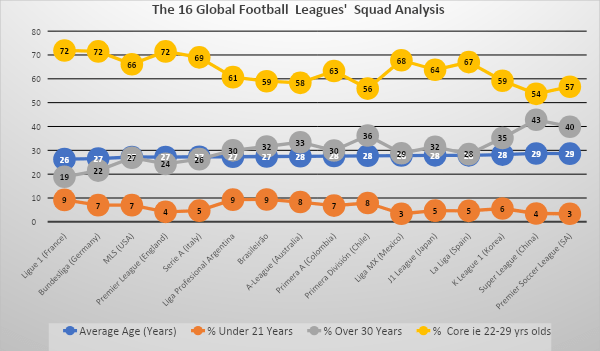
So how do the global leagues compare? France’s Ligue 1 is the top overall league for youth development with 9% of the players on the field being under 21 and 19% (less than 3 players per match) of the players on the field is over 30 years with 72% of the on-field be 21-29 years old. Germany’s Bundesliga is the only other league with an average age under 27 (the numbers above are rounded off) teams in the field. Brazil and Argentina also play young players but have a much higher % of over 30s than the top leagues. For the first time, we can say quite categorically that, SA ranked lowest on the percentage of young players fielded in a season at just 3% the status we share with Mexico, also SA has the joint oldest on-field team of any of these leagues 29 years together with China and finally second only to China (long regarded as the retirement village of world football) on the highest percentage of players of over 30 years old and older playing in the league at 39.9%. SA is in the bottom 3 leagues for the lowest % of the core squad i.e. 21-29-year-old players along with China,
No nation can progress its football when it shows such disdain for its young talent. Youth development is inextricably linked to South Africa’s football growth and development. Today, SA football has stalled others will argue it has regreased. It faces unprecedented challenges of declining match attendances and television audiences and delivering sub-standard performances internationally i.e. not qualifying or winning African club and national team competitions. I will put my neck out and say its starts with a poor quality product that South African football serves as a direct result of years of neglect of youth development. It’s no accident that France, Germany, Brazil, and Argentina today have some of the best young players in the world. They find them, develop and play them. The PSL leadership and the clubs need to act for their well-being. Ultimately, however, SAFA as the football mother body needs to enforce stricter home-grown talent regulations to safeguard the game, its future and its sustainability. The current trajectory is catastrophic.